Skip to content

If you own a home on the South Shore of Massachusetts, the way your property drains can have a major impact on its long-term condition. From Quincy to Plymouth, heavy rainfall, snowmelt, and repeated freeze-thaw cycles can shift soil, erode landscaping, flood basements, and send water straight toward your home’s foundation. If you have questions about South Shore land grading cost, then we have the answers and guidance you have been looking for.
Professional land grading services reshape the slope and elevation of your property so water flows safely away from your home instead of pooling where it can cause costly damage. More than a cosmetic improvement, proper property grading helps protect your foundation, preserve your landscaping, and reduce the risk of erosion and drainage problems for years to come.
South Shore properties each present their own grading challenges. Older Colonial and Victorian homes often have settled soil that no longer drains properly, while coastal communities like Hingham and Marshfield contend with saturated ground and salt-influenced soils. Even newer homes frequently require final site grading before landscaping, patios, or other outdoor projects can be completed.
Professional local land grading services do more than level your yard—they improve drainage, protect your foundation, and prepare your property for landscaping or construction. Our experienced land grading contractors can recommend the right solution for your property’s unique soil and drainage conditions. In this guide, we’ll explain what professional land grading services include and everything you need to know to get started.
Whether you’re preparing for landscaping, fixing drainage problems, or protecting your home’s foundation, our experienced South Shore grading specialists are here to help. Contact us today to schedule your free property assessment.

Common Property Problems That Professional Land Grading Can Help Solve
Not every drainage or landscape issue requires the same solution, but many common property problems can be significantly improved with professional land grading. The comparison table below highlights where grading is typically the best solution, when it may need to be combined with additional drainage systems, and when other structural repairs may also be necessary. Understanding the root cause of the problem is the first step toward protecting your home and avoiding more costly repairs in the future.
| Common Property Problem | Can Land Grading Help? | Additional Solutions Sometimes Needed |
| Standing water after rain | ✅ Yes | French drains for severe pooling |
| Water is collecting near the foundation | ✅ Yes | Downspout extensions if roof runoff is excessive |
| Wet or damp basement | ✅ Often | Waterproofing may also be needed for existing leaks |
| Soil erosion on slopes | ✅ Yes | Retaining walls or erosion control on steep grades |
| Soggy lawn that never dries | ✅ Often | Drainage systems for clay-heavy soils |
| Water flowing toward the house | ✅ Yes | Regrading is typically the primary solution |
| Uneven yard before landscaping | ✅ Yes | Topsoil, seeding, or sod after grading |
| Preparing for a patio or driveway | ✅ Yes | Compaction and excavation may also be required |
| Frost heave affecting walkways | ✅ Often | Improved drainage and proper base preparation |
| Foundation settlement caused by drainage | ⚠️ Sometimes | Structural foundation repairs may be necessary if damage has already occurred |
While every property is unique, proper land grading is often the foundation of an effective drainage strategy. By directing water away from your home, stabilizing the soil, and creating a properly sloped landscape, grading helps prevent many of the issues that commonly affect South Shore properties. A professional assessment can determine whether grading alone is sufficient or whether additional drainage solutions will yield the best long-term results.
WHAT LOCAL LAND GRADING SERVICES ACTUALLY INCLUDE
Whether you’re correcting drainage problems or preparing for a new patio or deck, professional site grading in South Shore, MA helps create a stable, properly sloped surface. Understanding South Shore land grading cost starts with a thorough on-site assessment of your property.
Land grading is the process of reshaping the surface of your property to control how water moves across it. A professional grading contractor does not simply push dirt around. The work involves a detailed assessment of your existing slope, soil type, drainage patterns, and proximity to structures before any equipment moves.
Site Assessment and Elevation Analysis
Before any grading begins, a qualified land grading contractor will walk your property and evaluate the current slope relative to your home’s foundation, driveway, and any existing hardscaping. On the South Shore, this step is especially important because many properties have mature landscaping, tree roots, or buried utilities that affect how grading can be performed. The contractor will identify low spots where water collects, high spots that may be directing runoff toward your house, and areas where the soil has compacted or settled unevenly over time.
Soil Removal, Addition, and Compaction
Once the assessment is complete, the contractor will determine whether soil needs to be removed, added, or redistributed. In some cases, excess soil from one area of the yard is moved to fill a low spot elsewhere. In other cases, clean fill or topsoil is brought in to build up grade around the foundation or along a drainage path. After soil is placed, it must be compacted in layers to prevent future settling. Skipping compaction is one of the most common mistakes in do-it-yourself grading projects, and it leads to the same drainage problems recurring within a season or two.
WHY PROPER GRADING MATTERS FOR MASSACHUSETTS PROPERTIES
Working with a skilled and experienced local land grading services provider is the best way to ensure your home and property are protected from drainage woes- all yer long. The consequences of poor grading are more severe in New England than in many other parts of the country. Massachusetts averages around 47 inches of precipitation per year, and the freeze-thaw cycle between November and March adds a layer of stress that warmer climates never experience.
Foundation Protection and Water Intrusion
Water that pools against a foundation does not just cause dampness in a basement. Over time, hydrostatic pressure builds against foundation walls, leading to cracking, bowing, and in serious cases, structural failure. In Braintree and Quincy, where many homes were built in the mid-20th century on older foundation systems, this is a real and ongoing concern. Proper grading is the first line of defense against water intrusion, and it is far less expensive than foundation repair.
Frost Heave and Soil Movement
When water-saturated soil freezes, it expands. When it thaws, it contracts. This cycle, repeated dozens of times each winter in Massachusetts, causes soil to shift. Poorly graded lots that hold water are far more susceptible to frost heave, which can damage walkways, patios, retaining walls, and the foundation itself. Professional land grading services address this by improving drainage so that soil does not stay saturated long enough to cause significant freeze-thaw damage.
Not sure if your drainage problems can be solved with grading alone? Schedule a free on-site assessment with our South Shore team. We’ll evaluate your property’s slope, identify the cause of water issues, and recommend the most effective long-term solution.

THE LAND CLEARING AND GRADING PROCESS STEP BY STEP
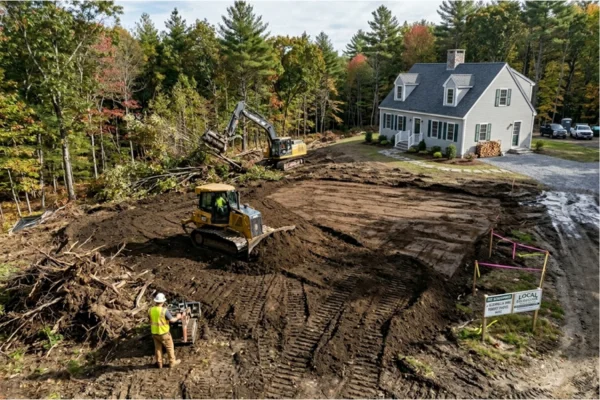
The land-clearing and grading process typically begins by removing vegetation, debris, and obstacles, then reshaping the land to ensure proper drainage. Professional clearing and grading services help ensure your property is ready for landscaping, hardscaping, or new construction.
Clearing the Site
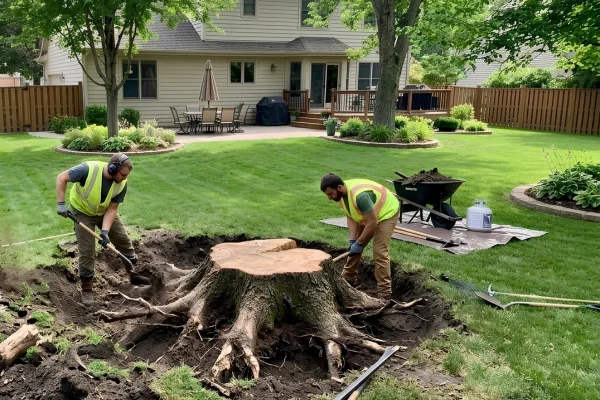
Land clearing involves removing trees, shrubs, stumps, rocks, and debris that would interfere with grading equipment or the finished grade itself. On coastal properties in Marshfield or Duxbury, this sometimes includes removing invasive plant species whose root systems have disrupted natural drainage patterns. Clearing must be done carefully to preserve any trees or plantings the homeowner wants to keep, and to avoid disturbing underground utilities.
Grading Execution and Final Shaping
Once the site is cleared, grading equipment — typically a skid steer, bulldozer, or motor grader, depending on lot size — is used to reshape the terrain. The operator works from the elevation plan established during the assessment phase, moving soil to achieve the correct slope away from structures and toward designated drainage points. Final shaping involves smoothing the surface, establishing clean transitions between graded areas and existing features, and preparing the ground for whatever comes next, whether that is seeding, sodding, hardscaping, or further construction.
MATERIAL AND DRAINAGE CONSIDERATIONS FOR SOUTH SHORE LOTS
Grading alone does not always solve every drainage problem and is just part of the local land grading services offered by South Shore Masonry. In many cases, property grading services are paired with drainage infrastructure to handle the volume of water that Massachusetts weather produces.
French Drains and Catch Basins
A French drain is a gravel-filled trench with a perforated pipe that collects groundwater and directs it away from problem areas. Catch basins collect surface runoff at low points and channel it through underground pipes to a safe discharge location. These systems work alongside proper grading to handle situations where the land’s natural slope is insufficient to move water quickly enough, or where the volume of runoff exceeds what surface grading alone can handle. In areas of Hingham and Plymouth where lots are large and rainfall runoff is substantial, combining grading with drainage infrastructure is standard practice.
Soil Type and Its Effect on Drainage
The South Shore has a varied soil profile. Sandy soils near coastal areas drain quickly but can erode easily. Clay-heavy soils found further inland hold water and are prone to expansion and contraction. A professional grading contractor will account for soil type when designing the grade and recommending any amendments or drainage additions. Importing the wrong fill material — or failing to account for existing soil behavior — can undermine the entire grading project within a few years.
HOW MUCH DO LAND GRADING SERVICES COST
Land grading cost varies based on the size of the area being graded, the amount of soil that needs to be moved or imported, site accessibility, and whether clearing or drainage work is also required.
Typical Pricing Ranges
For residential land grading in Massachusetts, most homeowners can expect to pay between $1,000 and $3,500 for straightforward grading work on a standard-sized lot. Larger projects or those requiring significant soil import, clearing, or drainage installation can range from $5,000 to $15,000 or more. Grading property around a house — specifically to correct the slope near the foundation — is often priced per linear foot of foundation addressed, with costs typically ranging from $500 to $2,000 depending on the extent of the work.
For a 1,000-square-foot yard area that needs leveling, expect to pay roughly $500 to $1,500, depending on how much the grade needs to change and whether fill material is needed. Land grading prices in Massachusetts tend to run slightly higher than national averages due to labor costs and the logistical demands of working in a region with a compressed outdoor construction season.
What Affects Your Final Cost
Several factors influence the final price of a grading project. Lot accessibility matters — a backyard that equipment cannot easily reach will cost more to grade than an open front yard. The presence of tree roots, rocks, or buried debris adds time and labor. If the project requires permits, which some Massachusetts municipalities require for significant grading work, that adds to the timeline and cost. Always request an itemized estimate from your grading contractor so you understand exactly what is included.
Every property is different, which is why accurate grading estimates require an on-site evaluation. Contact our team today for a no-obligation quote tailored to your property’s drainage, soil conditions, and grading needs.

HOW LONG DOES LAND GRADING TAKE
Most residential grading projects on the South Shore are completed in one to three days. Smaller jobs — such as correcting the slope around a foundation on a typical suburban lot — can often be done in a single day. Larger projects involving clearing, significant soil movement, or drainage installation may take a week or more.
On many South Shore properties we inspect, we find that improper grading around foundations—not failed waterproofing—is the primary cause of basement moisture. Correcting the grade often resolves the issue before more expensive repairs become necessary. This is one step you cannot and do not want to skip.
Hiring an experienced land clearing contractor or land grading contractor ensures your project is completed with the proper equipment, grading techniques, and drainage planning. Local expertise is especially important on the South Shore, where freeze-thaw cycles and coastal conditions create unique grading challenges. It may be tempting to consider a DIY project or cut corners, but that never pays off in the long run.
Seasonal Timing For Local Land Grading Services on the South Shore
In Massachusetts, the best time to schedule land grading is in the spring after the ground has thawed and dried out, or in late summer and early fall before the ground freezes again. Grading on saturated soil produces poor results because wet soil compacts unevenly and is difficult to shape accurately. Many South Shore homeowners schedule grading assessments in late winter so work can begin as soon as conditions allow in the spring.
CHOOSING THE RIGHT LAND GRADING CONTRACTORS FOR YOUR PROPERTY
Not every contractor who owns excavation equipment is qualified to grade a residential property correctly. The difference between a properly graded lot and a poorly graded one often comes down to experience, attention to drainage detail, and knowledge of local soil and climate conditions.
What to Look for in a Grading Contractor
A qualified land grading expert should be able to explain their assessment process clearly, provide references from completed residential projects in your area, and give you a written estimate that outlines the scope of work, materials, and timeline. They should carry proper licensing and insurance for work in Massachusetts. Ask specifically about their experience with properties similar to yours — whether that is an older Colonial in Braintree, a coastal home in Marshfield, or a new construction lot in Plymouth.
Why Local Experience Matters
A contractor who works regularly on the South Shore understands the soil conditions, drainage patterns, and climate demands specific to this region. They know that Massachusetts winters are hard on improperly prepared ground. They understand local permitting requirements and can help you avoid costly mistakes that a contractor unfamiliar with the region might make. When you hire a local specialist, you are not just paying for equipment time. You are paying for regional knowledge that protects your investment over the long term.
No High-Pressure Sales Tactics, Just Honest Land Grading Services
Standing water, poor drainage, and uneven grading rarely improve on their own—and delaying repairs can lead to foundation damage, landscape erosion, and more expensive fixes down the road. Whether you’re preparing for a new patio, correcting drainage problems, or protecting your home’s foundation, professional land grading is an investment in your property’s long-term health.
Masonry South Shore, MA proudly provides expert land grading and property grading services throughout Quincy, Braintree, Hingham, Marshfield, Plymouth, and surrounding South Shore communities. Our experienced team will assess your property’s slope, identify drainage concerns, and recommend the most effective solution for your home and budget.
Be sure to explore our project gallery to see how we’ve helped homeowners across the South Shore solve drainage issues and prepare their properties for landscaping, hardscaping, and long-lasting outdoor improvements.
Contact us today to schedule your free on-site grading assessment and no-obligation estimate. We’ll explain your options, answer your questions, and provide an honest recommendation based on your property’s unique conditions. Let us show you how easy it can be to get expert local land grading services that fit your budget and your needs.
FREQUENTLY ASKED QUESTIONS
What is the average price for land grading in Massachusetts?
Most residential land grading projects in Massachusetts cost between $1,000 and $3,500, while larger projects involving land clearing, drainage systems, or significant soil movement can range from $5,000 to $15,000 or more. Costs depend on lot size, accessibility, soil conditions, and project complexity.
What does land grading include?
Professional land grading includes evaluating your property’s slope, reshaping the terrain, adding or removing soil, compacting fill to prevent settling, and improving drainage. Depending on the project, grading may also involve land clearing, French drains, catch basins, or other drainage improvements.
How long does it take to grade land on a residential property?
Most residential grading projects take one to three days to complete. Larger projects involving land clearing, extensive soil movement, or drainage installation may require up to a week. Spring and early fall typically provide the best grading conditions in Massachusetts.
How much does it cost to level a 1,000-square-foot yard?
Leveling a 1,000-square-foot yard generally costs $500 to $1,500, depending on the amount of grading required, soil conditions, accessibility, and whether additional fill or drainage improvements are needed.
Why is proper grading especially important for South Shore homeowners?
Heavy rainfall, snowmelt, coastal conditions, and freeze-thaw cycles make proper grading essential on the South Shore. Correct grading helps move water away from your home, reducing the risk of basement leaks, foundation damage, erosion, and costly long-term repairs.
How do I know if my property needs professional land grading?
Signs you may need land grading include standing water after rain, soggy areas that never dry, soil erosion, water pooling near your foundation, a wet basement, or uneven ground before installing landscaping or hardscaping.
Can land grading fix drainage problems around my house?
Yes, in many cases. Land grading redirects water away from your home’s foundation and eliminates low spots where water collects. Some properties may also benefit from drainage solutions such as French drains or catch basins to maximize effectiveness.
Should I grade my property before installing a patio, driveway, or landscaping?
Yes. Proper grading creates a stable, well-drained foundation for patios, walkways, driveways, retaining walls, sod, and other landscaping projects. Correcting drainage issues before construction helps prevent settling, erosion, and expensive repairs later.