Skip to content
A tree stump is more than just an eyesore in your yard; it can actually be a hazard. Old stumps can get in the way of a new lawn, attract pests, and complicate future landscaping or masonry work. But do you need full stump removal, or is grinding enough? The answer to the debate of stump grinding vs. stump removal depends on your property plans, the stump’s location, and what needs to happen beneath the surface.
For most homeowners, stump grinding is faster and more affordable. However, if you plan to install a patio, retaining wall, walkway, or other structure where the stump once stood, full removal may be the better investment. This guide explains the difference between stump grinding and stump removal, what each costs on the South Shore of Massachusetts, and how to choose the right option for your property.
Let’s take a closer look now at what local homeowners and business owners need to know about Stump removal in the South Shore area.
Stump Grinding Services vs. Stump Removal Services: What’s the Difference?
The main difference is how much of the stump and root system is removed.
| Feature | Stump Grinding | Stump Removal |
| What is removed? | The visible stump and some of the upper roots | The stump and most of the root ball |
| Typical depth | Several inches below grade, depending on equipment and site | Deep enough to extract the stump and root mass |
| Equipment | Stump grinder | Excavator, backhoe, or other extraction equipment |
| Site disruption | Relatively limited | Larger hole and more soil disturbance |
| Cost | Usually lower | Usually higher |
| Best for | Lawn restoration and general landscaping | New construction, hardscaping, and complete site clearance |
| Root regrowth | Possible with certain tree species | Much less likely, although remaining roots may still produce growth |
Neither method is automatically better. The right choice depends on what you want to do with the space after the stump is gone.
What Is Stump Grinding?
Stump grinding uses a machine with a rotating cutting wheel to reduce the stump to wood chips. The grinder can usually cut below the surrounding grade, leaving a shallow depression you can fill and landscape. The remaining roots stay in the ground and gradually decompose.
Benefits of Stump Grinding
- Lower upfront cost than full stump removal.
- Faster completion for most residential properties.
- Less excavation and disruption to surrounding landscaping.
- Suitable for restoring lawns, planting beds, and other open areas.
- Wood chips can often be used as mulch or removed as part of the service.
For homeowners who simply want to eliminate an unsightly stump, grinding is often the most practical solution.
Limitations of Stump Grinding
The bigges drawback is that the root system remains underground. This is usually manageable for lawn restoration, but it can create complications when the area will support a new structure.
As roots decompose, they can leave gaps or weaker areas in the soil. If those areas fall beneath a patio, walkway, footing, or retaining wall, you may need additional excavation and base preparation.
The depth of grinding also matters. A stump ground only a few inches below grade may not provide enough clearance for a future project.

What Is Full Stump Removal?
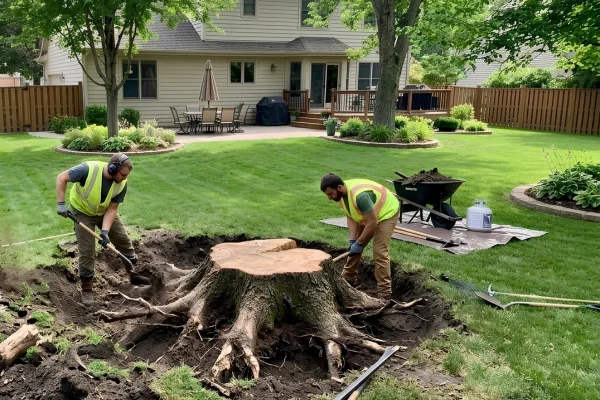
Full stump removal involves excavating and extracting the stump and much of its root ball. Depending on the tree’s size and location, the work may require heavy equipment and considerable digging.
After the stump is removed, fill the resulting hole with suitable material and compact it before the area is ready for construction or landscaping.
Benefits of Full Stump Removal
- Removes the main stump and most of the root ball.
- Creates a cleaner site for future construction.
- Reduces the risk of root interference beneath a new foundation or hardscape.
- Provides more control over excavation and soil preparation.
- Is often the better option when the stump is located where a structure will be built.
Full removal does not guarantee that every root is gone. Large trees can have extensive lateral roots that extend beyond the main stump. However, it removes substantially more of the material that could interfere with future work.

Is It Cheaper to Grind or Remove a Stump?
Stump grinding is generally less expensive than full stump removal in many cases. The final price depends on the stump’s diameter, location, accessibility, equipment requirements, and whether cleanup or debris removal is included.
Typical Stump Service Costs on the South Shore
The following are general planning ranges for stump grinding vs. stump removal, not fixed quotes.
| Service | Typical cost per stump |
| Stump grinding | Approximately $100–$400 |
| Full stump removal | Approximately $300–$800 or more |
| Hole filling and compaction | Additional cost, depending on excavation and fill requirements |
Larger stumps, difficult access, extensive root systems, and locations near structures or buried utilities can increase the cost of either service.
When comparing estimates, ask whether the price includes:
- Grinding or excavation depth.
- Removal of wood chips and debris.
- Disposal of the extracted stump.
- Filling and compacting the hole.
- Additional excavation if roots extend into the planned work area.
A lower initial price doesn’t always mean a lower total project cost. If you grind a stump before a masonry project and later need to excavate the remaining roots, the extra work can increase the overall budget.
When Is Stump Grinding the Better Choice?
Stump grinding is usually appropriate when the area will be used for ordinary landscaping rather than structural construction.
If You Plan to Restore Your Lawn
Grinding can quickly remove the visible obstruction and prepare the area for lawn restoration.
After grinding:
- Remove excess wood chips from the planting area.
- Fill the depression with suitable topsoil.
- Grade the area so water drains properly.
- Seed or sod once the soil is ready.
The remaining roots will decompose over time. Some settling may occur as organic material breaks down, so you may need to add more soil later.
If You Want to Create a Planting Bed
For a flower bed or ornamental landscaping, grinding is often sufficient. However, avoid planting another tree directly over the old stump location unless you remove the remaining wood and roots and the soil is suitable for the new planting.
If the Stump Is in an Inconvenient Location
Stumps near fences, driveways, or established planting beds can be difficult to excavate without disturbing nearby features. Grinding may provide the necessary clearance with less disruption.
When Is Full Stump Removal the Better Choice?
Full removal is generally the safer starting point when you’re installing a new structure, footing, or substantial hardscape.
If You Plan to Install a Patio or Walkway
A patio or walkway needs a properly prepared base. Organic material from old roots can keep decomposing, potentially creating weak spots or settlement beneath the installation.
Removing the stump and as much root mass as practical gives the contractor more control over excavation and base preparation.
This does not mean every stump near a patio requires complete removal. The decision depends on the planned excavation depth, root location, and project design.
If You Plan to Build a Retaining Wall
Retaining walls require more than a level surface. They need appropriate excavation, drainage, and a stable base that can support the wall and resist soil pressure.
A large stump or dense root system in the wall’s footprint can interfere with those requirements. You may need to remove it completely before construction begins.
If You Plan to Install Footings or Other Structures
Buildings, additions, decks with footings, and other structures require excavation to specified depths. Address any remaining stump or root material in that excavation area before installing the footing.
Your contractor should evaluate the location before deciding whether grinding is adequate or full removal is required.
Can a Tree Grow Back After Stump Grinding?
Sometimes the roots will remain alive for a time, and new growth can emerge from the root system after tree removal. Whether a tree regrows after grinding depends on the species and how much of the root system remains.
Many trees will not produce new growth after the stump has been ground down. However, some species are persistent and can send up shoots from lateral roots. This is one factor to consider in the stump grinding vs. stump removal debate. If you are unsure about the risk of regrowth, the South Shore Masonry team can help you here as well.

Tree Species That May Regrow
Homeowners in Massachusetts should be particularly aware of species such as:
- Silver maple.
- Norway maple.
- Black locust.
- Sumac.
- Sweetgum.
These trees can produce new shoots from roots that remain underground. Regrowth may appear several weeks or months after grinding, especially during the growing season.
If shoots develop, address them promptly. Repeated cutting may help manage regrowth, but persistent growth may require additional treatment or root removal.
When eliminating the tree’s root system is the priority, full stump removal is the more appropriate option.
Is It Better to Leave a Stump or Grind It Down?
Leaving a stump in place is rarely the best long-term choice for a residential property. It may be harmless in an out-of-the-way area, but it can create several practical problems.
Pest and Decay Concerns
Decaying wood can attract insects, including carpenter ants and other wood-boring species. A stump near a home or other wood structure deserves particular attention.
However, a stump does not automatically mean termites or other pests will enter your house. The risk depends on the stump’s condition, location, and surrounding environment.
Lawn Maintenance and Safety
Stumps can interfere with mowing, edging, and other yard work. They can also create trip hazards, particularly when hidden by grass or groundcover.
Appearance and Property Use
A visible stump can make a finished landscape look incomplete. It may also interfere with future planting, outdoor living areas, or other improvements.
Grinding is often the simplest way to address these issues without the disruption of full excavation.
South Shore Soil Conditions and Stump Work
The South Shore includes a mix of coastal sands, glacial soils, and heavier soils farther inland. These differences affect drainage, excavation, and how to prepare a site after stump work.
Freeze-thaw cycles also matter. Water in the soil can freeze, expand, and contribute to movement in poorly prepared hardscape installations.
That does not mean every ground stump will cause a patio or walkway to fail. The risk depends on the amount of remaining organic material, soil conditions, drainage, excavation depth, and base preparation quality.
For this reason, stump work should be considered as part of the larger landscaping or masonry plan—not as an isolated task.
How Stump Work Affects Future Masonry Projects
If you are planning masonry work near a former tree location, tell your contractor whether the stump was ground or fully removed.
That information helps the contractor assess:
- The likely location of remaining roots.
- Whether additional excavation is needed.
- How deep the base should be prepared.
- Whether the soil contains organic material.
- Whether drainage improvements are necessary.
- How the stump location may affect the project schedule and cost.
What Happens If a Stump Was Already Ground?
A previously ground stump does not automatically prevent a masonry project. In some cases, the contractor can excavate deeper, remove remaining root material, and rebuild the base.
In other cases, especially when a large stump leaves behind a dense root mass, you may need additional removal before construction begins.
The important point is to evaluate the site before installing the patio, walkway, retaining wall, or other feature.
Stump Grinding or Removal: Which Should You Choose?
Use this quick guide to compare your options for local stump and tree services in the South Shore area.
| Your property plan | Recommended starting point |
| Restore an existing lawn | Stump grinding |
| Create a flower bed | Stump grinding |
| Remove an unsightly stump | Stump grinding |
| Plant another tree in the same location | Evaluate full removal |
| Install a patio over the stump location | Full removal or site-specific excavation |
| Build a retaining wall | Evaluate full removal |
| Install footings or a foundation | Full removal within the excavation area |
| Clear a site for new construction | Full removal |
When in doubt, discuss your plans with the contractor before choosing a service.
How Masonry South Shore MA Can Help
At Masonry South Shore MA, we understand that stump work and masonry work often overlap. A stump that seems like a minor landscaping issue can become a construction concern when it is located where a patio, walkway, retaining wall, or footing will be installed.
Our team evaluates the planned work area, considers the existing site conditions, and helps homeowners understand what needs to happen before construction begins.
If a stump has already been ground, we can assess whether the remaining root material will affect the planned project and whether additional excavation or base preparation is needed.
The goal is straightforward: prepare the site properly so your masonry installation has the stable foundation it needs.

Planning Masonry Work on the South Shore?
If you have a stump on your property and are considering a new patio, walkway, retaining wall, or other masonry project, address the stump before construction begins.
Masonry South Shore MA offers free on-site assessments for homeowners in Quincy, Braintree, Hingham, Marshfield, Plymouth, and surrounding communities. We can discuss your plans, evaluate the site, and explain the preparation required before work starts.
Contact us today to schedule your free estimate and take the next step toward a properly prepared outdoor space. Don’t try to answer the stump grinding vs. stump removal question on your own; let our team help.
Frequently Asked Questions
Is it cheaper to grind or remove a stump?
Stump grinding is generally cheaper than full stump removal because it requires less excavation, labor, and equipment. On the South Shore, grinding may cost approximately $100–$400 per stump, while full removal may range from $300–$800 or more. Your final cost depends on stump size, access, root conditions, and whether cleanup and hole filling are included.
Is it better to leave a tree stump or grind it down?
Grinding is usually the better choice for homeowners who want to eliminate an unsightly stump and make the area easier to maintain. Leaving a stump can create mowing obstacles, trip hazards, and decay-related concerns. If the stump is located where a structure will be built, full removal may be more appropriate.
What is the average cost to have a stump removed in Massachusetts?
Full stump removal commonly costs approximately $300–$800 per stump for standard residential situations, although larger stumps and difficult locations may cost more. Ask whether the estimate includes filling and compacting the resulting hole, since those steps may be necessary before landscaping or construction.
Will a tree grow back if I grind its stump?
Some trees can regrow after stump grinding because their lateral roots remain underground. Silver maple, Norway maple, black locust, and sumac are examples of species that may produce new shoots. If regrowth becomes a problem, you may need additional treatment or root removal.
How does stump grinding affect a future masonry or patio project?
Stump grinding leaves roots in the ground. As those roots decompose, they may create weak spots or settling beneath a future hardscape installation. A contractor should evaluate the area before construction to determine whether additional excavation, root removal, or base preparation is needed.
How deep should a stump be ground before landscaping?
The required depth depends on the planned use of the area. A lawn or planting bed may need less excavation than a patio, walkway, or footing. If you plan masonry or construction, the contractor should determine the required excavation depth and whether to remove the remaining roots.